

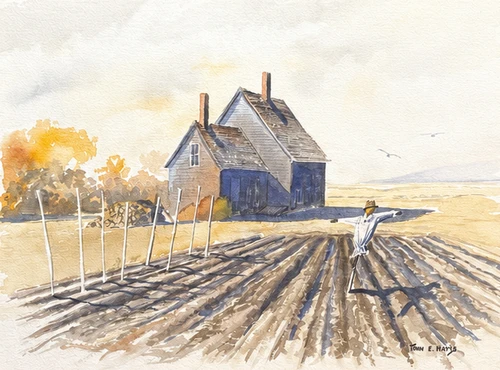
Title: “Crows Beware”
Artist: John E. Harris
Period: 20th century
Medium: Watercolor and gouache on paper
Dimensions: 17.5" x 21.5"
This 20th-century New England regional watercolor captures the crisp, bittersweet atmosphere of an autumn harvest field. John E. Harris presents a quiet scene of traditional farm life, centered on a lone scarecrow keeping watch over dark, freshly tilled furrows before a weathered clapboard farmhouse.
Gallery Description
In this finely executed watercolor, Harris creates a luminous rural landscape within a 17.5" x 21.5" format. The viewer is placed at ground level, looking across the strong diagonal rhythm of a harvested field. The lower portion of the composition is dominated by raw earth furrows, rendered in layered sweeps of sepia, raw umber, and charcoal grey that convey the weight and texture of tilled soil.
The narrative focus is the rustic scarecrow positioned in the right foreground. Dressed in a tattered white coat and straw hat, it stands with outstretched arms, casting a sharp geometric shadow across the field. On the left, a row of white wooden stakes or bean poles adds vertical structure and balances the composition against the scarecrow’s strong presence.
In the midground, a classic multi-gabled New England farmhouse anchors the scene. Its weathered grey clapboard siding and two brick chimneys are set against a vivid burst of autumn foliage in copper orange, cadmium yellow, and warm amber tones. Above the horizon, transparent washes of pale yellow and white create a hazy sky, where two birds circle over the distant hills. Presented in a custom wooden gallery frame with a wide moss-grey mat, the work conveys rural stillness, seasonal warmth, and enduring Americana charm.
Style and Composition
Artistic style: Mid-20th-century American Regionalism with realist watercolor illustration qualities.
Composition: A ground-level landscape organized by strong linear perspective. The soil furrows guide the eye into the scene, while the central farmhouse and right-foreground scarecrow create an asymmetrical but balanced arrangement.
Focal point: The scarecrow in the right foreground, whose bright white coat stands out against the darker earth tones.
Color palette: A refined autumn range of deep sepia, raw umber, and stone grey, softened by copper orange, marigold yellow, and creamy sky washes.
Lighting and atmosphere: Low, late-afternoon light casts long shadows across the furrows, creating a crisp, nostalgic countryside mood.
Application and Technique
Brushwork and mark-making: Harris combines transparent washes with precise dry-brush line work. The washes build atmosphere in the sky and background hills, while controlled linear details define clapboards, brickwork, branches, and field textures.
Layering and depth: The composition achieves strong spatial recession through value contrast and perspective. Dark foreground ridges and pale stakes draw the viewer forward, while softer, lower-contrast hills recede into the distance.
Materials and tools: Transparent watercolor and opaque white gouache are applied to heavyweight fine art paper. Fine detail brushes appear to have been used to preserve clean architectural edges and crisp linear accents.